
Towns County Criminal Docket Searches
Felony dockets in Towns County run through Superior Court. The official Georgia Courts E-Access directory lists Towns Superior and points the way to PeachCourt. A free PeachCourt account is required. If you have a case number from a notice, accusation, indictment, or order, search with it exactly. No number? Use the party-name search, then confirm the county, court, case type, filing date, and caption before opening anything.
A case missing online does not mean it does not exist. The record could be old, unindexed, restricted, juvenile, or simply held by another court. Fallback channels for a Towns County criminal docket include the clerk counter, telephone, mail, fax if authorized, and a generic web contact form. That form can ask how to obtain a record. It is not an e-filing or certified-copy request form.
- Select Cases, Towns County, and Towns Superior in PeachCourt.
- Enter the exact case number, or search the party name as filed.
- Verify the result header before choosing “View Case Docket.”
- Read the events in date order and locate the newest setting, order, plea, or disposition.
- Call the proper clerk if the result is unclear, incomplete, or absent.
- Request a clerk-certified record when an official copy is required.
Eric Barrett, Clerk of Superior Court, answers at 706-896-2130. The counter sits at 48 River Street, Suite E, in Hiawassee, second floor, Monday through Friday, 8:30 a.m. to 4:30 p.m. County renovation notices have also named a temporary site, so confirm the current location before making the trip.
Towns Criminal Search in PeachCourt
The PeachCourt court search does two jobs. It is a case-search route and part of Georgia's filing system. Its documented controls include Cases, Filings, and Users modes. County and court selectors, a case-number field, party-name search, a result row, and "View Case Docket" round out the page. Note the limits. The Users mode is not a case lookup. And "File into this case" is an authorized filing action, not a public-record request button.
The official search page displays the interface before any personal result is opened.
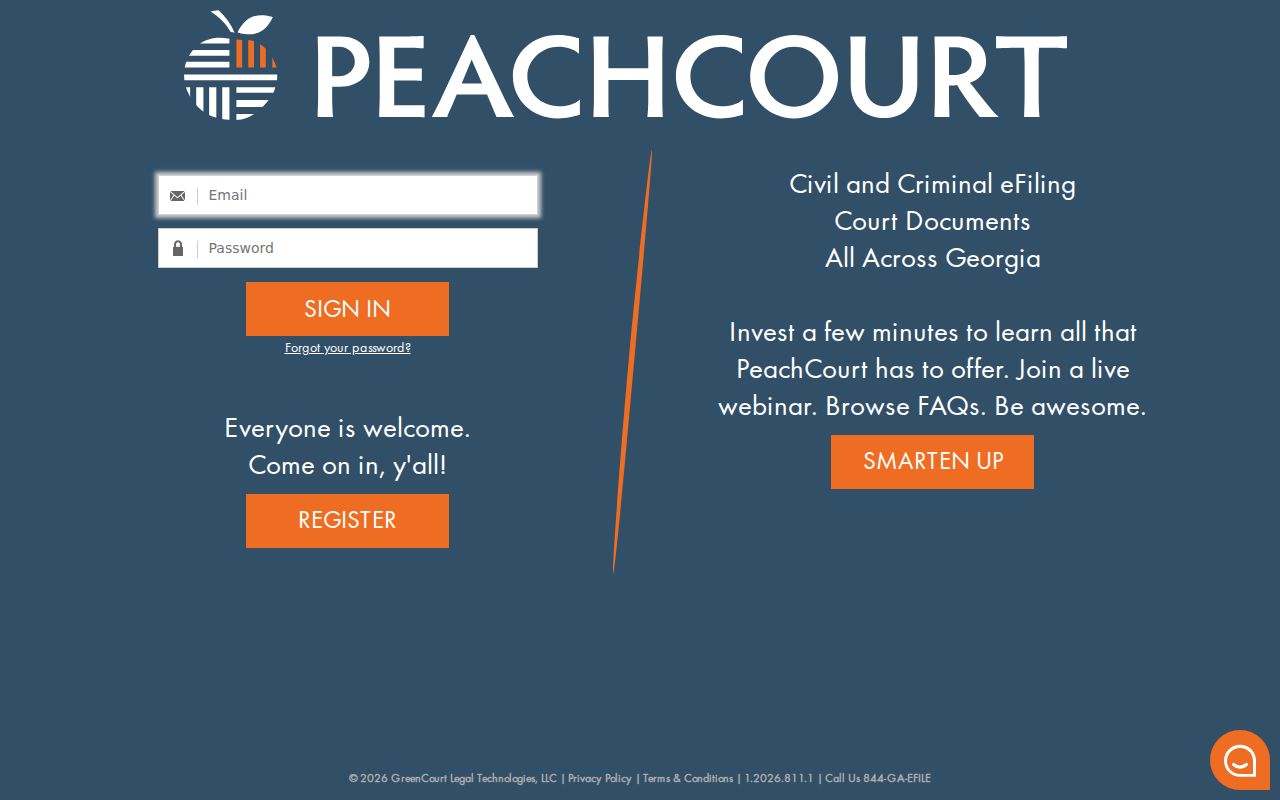
The provider does not cover every local court, so that distinction matters in Towns County. Pick Towns Superior for felony matters and keep the court field narrow. Probate, Magistrate, municipal, or confidential Juvenile searches may need the office that keeps those records instead.
Criminal Dockets: What They Show
A Towns County criminal docket is a chronological register, not the full text of each filing. Read the case header and the event list together. Towns County publishes no official case-number pattern or abbreviation sheet. So copy the identifier exactly from a court document. Do not invent a prefix or change its punctuation.
| Case header | Case number, Towns Superior, criminal case type, filing date, status, and judge if displayed. |
|---|---|
| Charges | Count or charge descriptions and accusation or indictment events; a pending charge remains an allegation. |
| Representation | Prosecutor, defense counsel, and attorney fields when public and indexed. |
| Settings | Arraignment, motion, pretrial, trial, sentencing, reset, or continuance entries with available date details. |
| Outcome | Plea, dismissal, nolle prosequi, conviction, sentence, appeal, or reopen events as actually labeled. |
| Documents | Links to public images, plus costs or balances where the provider exposes them. |
An event line may prove an order was entered, but it is not always the signed order itself. The same caution applies to a sentence or final disposition. When the exact legal effect matters, get the filed document or a certified copy.
Towns Criminal Reset Is Not Dismissal
A reset or continuance just moves a setting. It does not end the Towns County criminal case. Older hearing dates can linger in the history after a new date is entered, so read forward to the newest event and compare it with the latest signed notice or order. If those conflict, contact the clerk or court office rather than guessing which date controls.
- Arraignment
- A formal stage at which the charge is addressed and a plea may be entered.
- Continuance or reset
- A scheduled event moved to another date or setting.
- Disposition
- The recorded outcome of a case or count, which must be read in context.
- Nolle prosequi
- A prosecutor's abandonment of a charge, as reflected in the filed record.
Georgia emergency orders can also supersede a date shown in an earlier docket entry. A historical setting proves only what was scheduled then. It is not automatic proof of the next live setting.
Criminal Case Stages on the Docket
A Towns County felony may begin with law-enforcement or warrant activity. That activity never touches the Superior Court file. The court case advances once an accusation or indictment is filed. Bond, arraignment, motions, discovery, pretrial conferences, continuances, trial, plea, sentencing, and appeal can each add later docket events. Not every operational detail or document image appears online.
Docket flow: Referral or warrant › Accusation or indictment › Arraignment › Motions and pretrial settings › Plea or trial › Disposition and sentence › Appeal, if filed
The sheriff's record and the district attorney's working file are related sources. Neither replaces the Towns County criminal docket the clerk keeps. And a hearing entry does not establish that the hearing occurred or that the court made a factual finding.
Towns Criminal E-Filing Route
The Georgia Courts e-filing directory lists Towns Superior as mandatory PeachCourt e-filing. In practice, PeachCourt accepts authorized filings. It also serves as the public-facing docket provider for participating Superior cases. That does not mean any visitor can add a document. Nor does it mean every lower-court file appears there.
The official directory shows Towns County's place in the statewide e-filing framework.
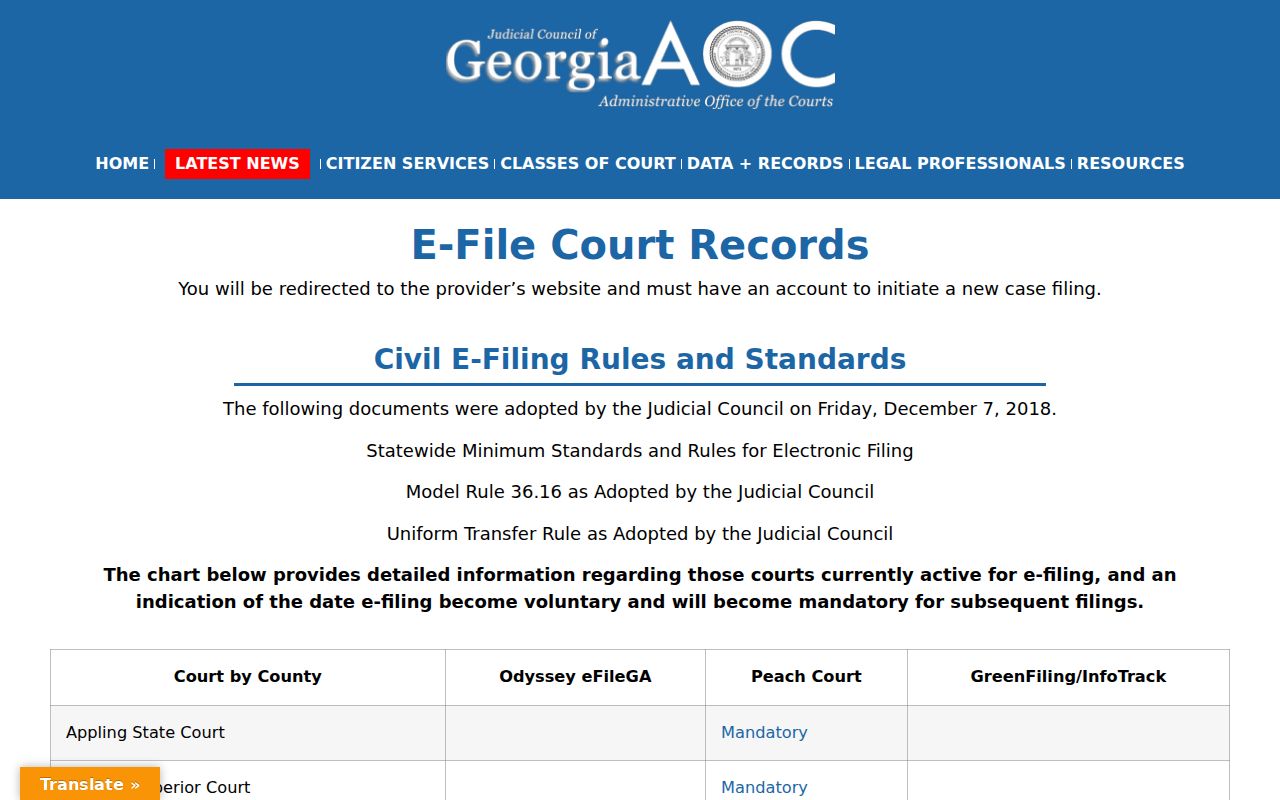
An accepted filing may produce a title and date on the Towns County criminal docket. The image itself may still be unavailable. PeachCourt states that available document images cost $0.50 per page plus a small convenience fee. That is a provider charge, not the clerk's fee for a plain or certified copy. The clerk's copy fee is not published.
Towns County Criminal Docket Courts
For a Towns County criminal docket on a felony charge, start with the Superior Court. It sits within the Enotah Judicial Circuit, which covers four counties. Towns County has no separate State Court of its own. Skip any presumed State Court portal when you search. Where no State Court exists, the Probate Court can take county traffic. It also takes some misdemeanor cases. Magistrate Court handles warrants and early preliminary matters. Inside Hiawassee city limits, the Municipal Court keeps traffic and ordinance cases on its own docket.
| Venue | Criminal docket role | Record route |
|---|---|---|
| Towns Superior | Felonies and related Superior criminal proceedings | PeachCourt or Eric Barrett's office |
| Probate/Magistrate | County traffic, eligible misdemeanors, warrants, and preliminary matters | Suite C counter or 706-896-3467 |
| Hiawassee Municipal | City traffic and ordinance matters | City Hall or 706-896-2202 |
| Juvenile Court | Delinquency and other juvenile matters | Separate access analysis through the court |
Pick the right court first. That single step saves the most time. An appeal moves the fight to the Georgia Court of Appeals or the Supreme Court of Georgia, but it does not pull the trial docket away from the Towns County clerk, and a second record may exist up there as a result.
Towns Dockets in Enotah Circuit
The Enotah District Attorney prosecutes for Towns, Union, White, and Lumpkin counties. The office's own page reports nearly 2,000 criminal referrals each year. They come from more than 20 law-enforcement agencies. Those are circuit-wide figures, though. They are not Towns County case totals, and they do not count filed Superior Court dockets here.
The current Enotah Superior Court contact page lists the judges who serve the circuit. Treat it as circuit context only, not as an assignment for any one case.
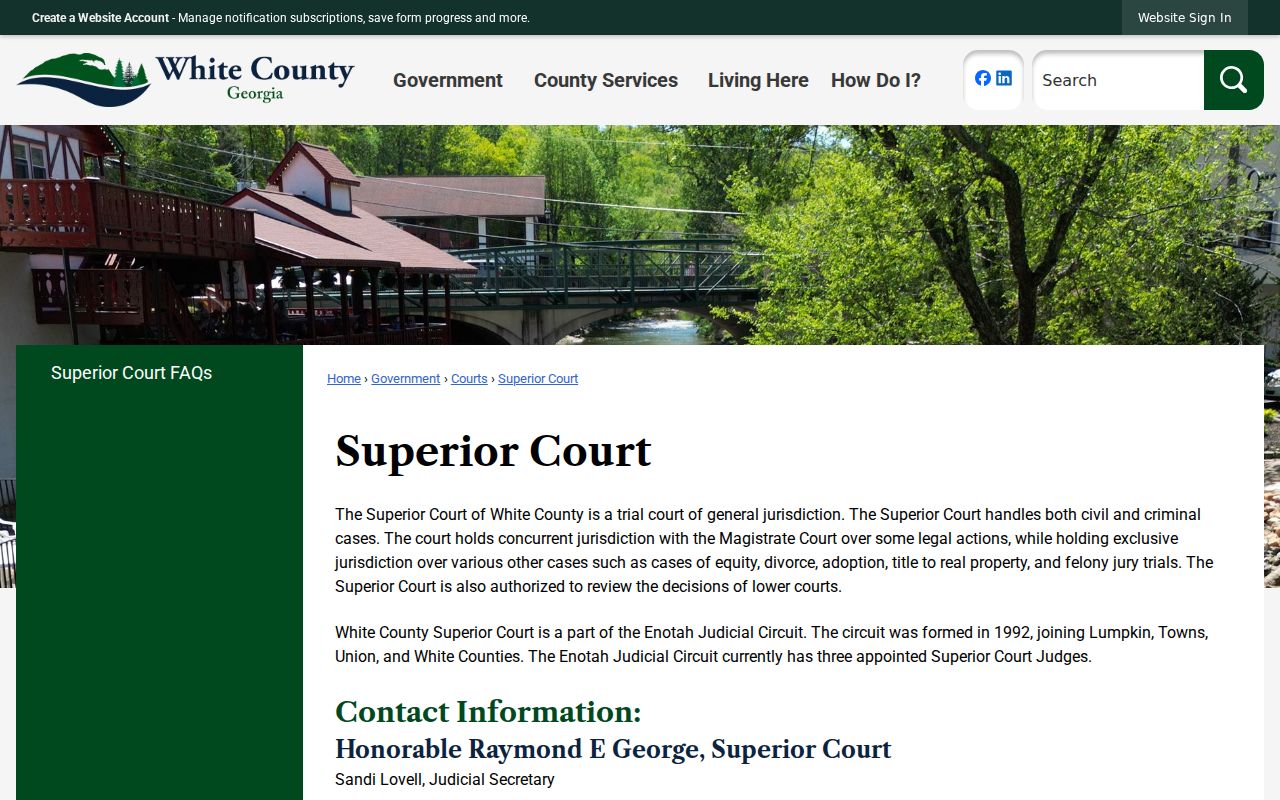
A judge may sit in an office well outside Hiawassee. Venue can still be Towns County. For the judge on a specific matter, rely on the case header, the setting notice, or a signed order.
Towns Specialty Criminal Docket Events
Three problem-solving programs operate through the four-county circuit. These are the Enotah Family Treatment Court, the North Enotah Felony Drug Court, and the Enotah Mental Health Court. None of them is a public database of participant treatment records. Instead, a public user should watch the underlying Superior case for permitted events. A referral, plea, review, graduation, violation, or sentencing may appear there. A Towns County criminal docket can show one limited event. It does this without exposing the program's full file.
Handle medical, treatment, juvenile, and other protected details with care. When a detail is absent, do not infer it from another source.
Access Rules for Criminal Dockets
Uniform Superior Court Rule 21 is the main access reference for a Towns County Superior Court docket. The rule starts from openness. Law or court process can still restrict access. Rule 21.6 governs protected identifiers and redaction. Even when an image is removed, redacted, sealed, or limited to an authorized user, the docket itself can stay public.
Key access rules:
Uniform Superior Court Rule 21 governs public access and judicial restriction of Superior Court records.
Rule 21.6 protects identifiers through redaction requirements.
Juvenile confidentiality and a sealing order require a separate access decision; a blank search is not proof of no case.
Courts do not answer to the Georgia Open Records Act the way ordinary agencies do. The Georgia Attorney General explains this point. So send a criminal court-file request straight to the relevant clerk, following court procedures. If access gets limited, ask what authority applies and whether a redacted copy exists. It also helps to know what you want: a docket, a filed document, a transcript, or a certified record. Clerks treat those differently.
Criminal-history restriction is its own process, separate from access to the Towns County criminal docket. The official Georgia record-restriction resource covers that path. A docket search never substitutes for the court's signed record.