
Towns County Court Record Requests
Venue comes first in any Towns County court record request. Eric Barrett is the Clerk of Superior Court. His office keeps Superior Court civil, criminal, domestic, and juvenile proceeding records. Estates and guardianships run through the Probate/Magistrate office. So do magistrate civil matters, dispossessory filings, small claims, and county traffic tickets. Hiawassee Municipal Court keeps its own city-ticket and ordinance files. The district attorney, sheriff, and police may hold related material. None of them has the complete court file.
The full chain matters when an online result falls short. For Superior Court, start with Georgia Courts E-Access. It lists Towns Superior. It routes to PeachCourt. A free account is required. For an older record, an unindexed document, inspection, or certification, the clerk counter is the sound fallback. Call ahead for mail instructions, payment methods, identification needs, and the current counter location. The clerk publishes a fax number. There is no general fax-request procedure. There is no direct email address either. Its web contact form can ask how to proceed. It is not a filing or records-request form.
- Identify the court, case number, party name, approximate filing date, and exact document sought.
- Check the official online docket for a Superior Court case, or contact the proper lower-court clerk.
- Ask whether inspection, a plain copy, certification, or exemplification is required.
- For mail or fax, obtain the clerk's current instructions before sending funds or personal data.
- Confirm the fee, turnaround, delivery method, and any restriction before placing the order.
Three Towns Court Record Counters
Towns County has no universal records counter. Superior and Juvenile records sit with the Superior Court clerk. The Probate/Magistrate office sits at Suite C. Its records cover estates and guardianships. They also cover magistrate civil matters, dispossessory cases, and county traffic. City citations and ordinance matters heard in Hiawassee stay with the municipal clerk. That clerk sits at City Hall. That split explains why a correct name search in one system may yield no result.
Pick the court from the first filed notice, summons, citation, or order. A major civil action or felony matter generally points to Superior Court. A small civil claim may point to Magistrate Court. An estate points to Probate Court. Juvenile records carry added confidentiality controls even though the Superior clerk manages them. If the venue stays unclear, call the office with the document in hand. Read the court heading aloud rather than sending the same request to several agencies.
Superior Court Clerk
48 River Street, Suite E
Hiawassee, GA 30546
706-896-2130
Probate/Magistrate Office
48 River Street, Suite C
Hiawassee, GA 30546
706-896-3467
Note: Before traveling to the River Street complex, confirm whether courthouse work has moved a counter.
Kinds of Court Records
A docket is a chronological index. It is not always the whole Towns County court case record. The docket may show that a complaint, motion, return of service, order, plea, judgment, or other event was entered. The document itself is a separate layer. A browser view can be enough to track an event. Reading the text takes a filed image or a clerk copy. A transcript is yet another product. It is prepared by the court reporter rather than copied from the clerk's file.
- Docket sheets and event histories showing the course of a case
- Complaints, petitions, answers, motions, and other filed pleadings
- Signed orders, judgments, sentences, and dispositions
- Returns of service, notices, and hearing-related filings
- Available exhibits, attachments, and document images
- Certified or exemplified copies issued through the proper clerk
Some records are public only in part. An event may appear on the docket while the linked PDF is absent, redacted, sealed, or available only at the counter. That is not proof the document was never filed.
Towns Superior eCertification Route
The GSCCCA participating-county list includes Towns Superior Court. Its eCertification service exists for a digitally certified document, not a broad docket search. The requester selects the county and document type. Then a request is submitted and payment authorized. An authenticated PDF arrives once the clerk completes it. An authentication code can be checked later through the portal.
Use this channel when a certified electronic copy is needed. The record must fall within Towns Superior custody. The portal does not display a Towns-specific charge before the account and request steps. Read the quoted fee. Confirm it before authorizing payment. Probate, Magistrate, Municipal, and federal records follow their own custodians. A printed PeachCourt screen does not become certified merely because it came from an official provider.
Court Records: What They Contain
What sits inside a Towns County court case record depends on case type and access status. The docket ties core identifiers to a time-ordered event list. Filed documents then supply the text behind those entries. Before ordering an image, match the court, case number, caption, filing date, and current status. This matters when names are common. It also matters if a case has moved through more than one court.
| Case Number | The court's local identifier. No verified Towns sample format was published, so copy it exactly from the notice or docket. |
|---|---|
| Parties and Roles | Public caption and roles such as plaintiff, defendant, petitioner, or respondent. |
| Pleadings | Filed petitions, complaints, answers, motions, and responses that are open to public access. |
| Orders and Judgments | Signed court rulings, dispositions, and judgments when not sealed or restricted. |
| Docket Sheet | A chronological list of filing, service, hearing, order, and disposition events. |
| Document Links | Images available through the provider; some events have no public PDF. |
Never infer a code's meaning from its letters alone. When a status or abbreviation is unclear, use the event text, the filed order, and the clerk's explanation.
When Towns Records Lack PDFs
Sometimes PeachCourt lists a filing or an order but offers no document image. Provider materials say image coverage varies and never promises every historical paper. Restricted material can also be summarized or hidden. First confirm the search points to Towns County and the correct court. Then write down the exact event date and description. That gives the clerk a narrow target. Ask whether the item can be inspected, copied, or certified. Ask whether it is stored off site. Ask whether it exists only on paper. For anything sealed or confidential, staff cannot work around the governing order. A party may need to follow a court process for access. Juvenile files carry stricter limits. So do adoption matters, protected identifiers, and material under a protective order. A gap online proves nothing either way. It does not prove the case is closed. It does not prove the event never occurred.
Copy Fees and Certification
Copies come in three grades. A plain copy just reproduces the document the clerk has on file. A certified copy carries the clerk's formal certification. An exemplified copy goes further with a higher form of authentication, the kind you request only when the receiving body demands it. Towns County posts no local fee schedule for plain, certified, or exemplified copies. It posts none for search work either. One caution applies: GSCCCA UCC filing fees belong to a different records system. Never apply them to a court-file request.
| Item | Verified Amount or Status |
|---|---|
| PeachCourt document image | $0.50 per page plus a small convenience fee |
| Plain court-file copy | Towns-specific fee not published; ask the proper clerk |
| Certified or exemplified copy | Towns-specific fee not published; obtain a quote |
| GSCCCA eCertification | Available for Towns Superior; charge appears in the request process |
| Court reporter transcript | Separate reporter product, not a clerk copy fee |
Transcripts cost a different animal than copies. A court reporter prepares and certifies the spoken record, so the price can run far beyond a normal copy fee. State reporter schedules give you rate context. But only the reporter can quote your actual request. Before paying, tell the clerk exactly what the receiving court or agency requires. That way you don't buy the wrong copy type.
Federal Records Beyond Towns Court
Towns County residents sometimes assume every court record lives at the county clerk's office. Federal cases do not. Towns sits in the Gainesville Division of the U.S. District Court for the Northern District of Georgia, which keeps its own filings entirely apart from the Towns County court docket. That federal clerk sets its own hours, security rules, fee schedule, docket numbers, and CM/ECF procedures. For a federal case lookup, PACER is the system that locates cases and opens the underlying documents.
The official Gainesville federal courthouse page lays out the division office, its hours, and how to reach the staff who handle these dockets.
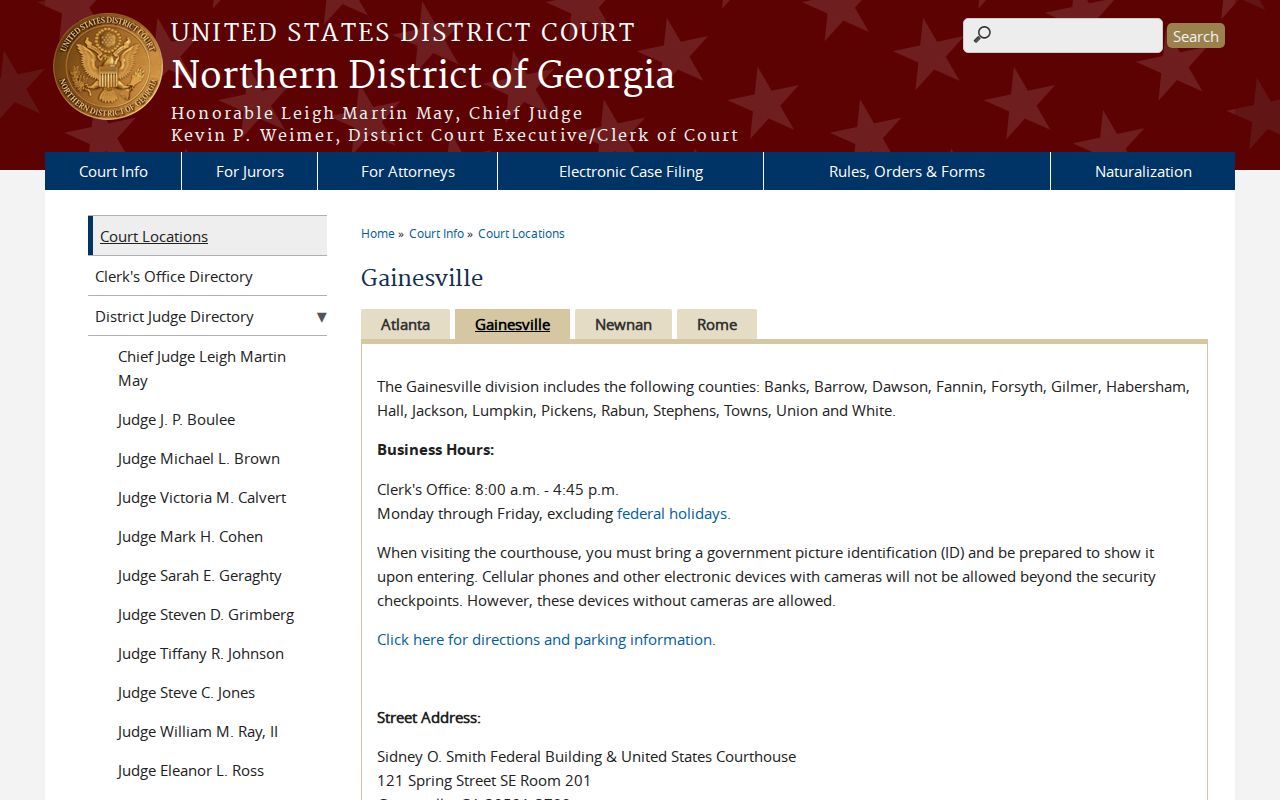
This federal office is a separate trip from the Towns County courthouse. Use it only when the case belongs in federal court. The PACER service page identifies the national federal docket route.
None of this touches the Towns County Superior, Probate, Magistrate, or Municipal court dockets, since PACER's coverage and billing rules apply only to federal files. Some federal case records also surface for free in the nonprofit CourtListener RECAP archive.
Treat RECAP as a free fallback, not a substitute. Its collection is incomplete, and it cannot certify an official copy of any federal court record.
Towns Court and Agency Records
Georgia keeps court-file access and ordinary agency open-records requests in separate lanes. Under the Attorney General's open-government FAQ, courts do not fall under the Georgia Open Records Act. That sets them apart from executive agencies. So a Towns County pleading or order goes to the court clerk. Court access rules govern that request. An Open Records Act request still fits records held by a non-court county agency. But it brings no three-business-day promise for a court case file.
Knowing the difference saves time. Describe the record by court, case number, party name, document title, and date. An item can belong to an administrative agency rather than a court file. If so, ask which official keeps it. Skip the generic clerk contact form for filings. And do not attach a pleading unless the clerk or the filing system tells you to.
Access Rules for Court Records
Uniform Superior Court Rule 21 presumes public access to court records. Some files can be limited, though, when law or court procedure calls for it. Rule 21.6 covers protected identifiers and redaction. Juvenile cases, adoptions, sealed files, and similar confidential material may be withheld, partly redacted, or shown only to authorized viewers. Even so, a Towns County docket entry can stay public. The document behind it stays restricted.
The Georgia judicial-security program spells out personal-information protections under O.C.G.A. §15-5-112. Those protections are not database errors. They are rules the clerk must follow. If you are denied access, ask a simple question. Which rule or order controls, and what court process might still be open to you?
For the current access framework, see the official Georgia court-rules landing page.
Check the rules hub for amendments before relying on a saved copy.
Key access rules:
Uniform Superior Court Rule 21 governs access and restriction of Superior Court records.
Rule 21.6 requires protection or redaction of specified identifiers in filed material.
O.C.G.A. § 15-5-112 provides a route to restrict covered personal information for protected people.